
Small Business Website Checklist: 15 Things Yours Must Do
Most small business websites in Brisbane fail the same way: they exist, they load eventually, and they tell you almost nothing useful. The phone number is buried in the footer. The hours are two years out of date. There are no photos of the actual business. The checklist below is the fifteen things a local business website must have to do its job — defined as converting a visitor who found you on Google into an enquiry or a customer. None of them are technical. All of them are decisions.
What’s in this guide
- The 15-point checklist
- Mobile-first: the one test that matters most
- Speed: the silent conversion killer
- Trust signals: what makes a stranger feel safe
- Local signals: the SEO layer most sites skip
- Frequently asked questions
The 15-point checklist
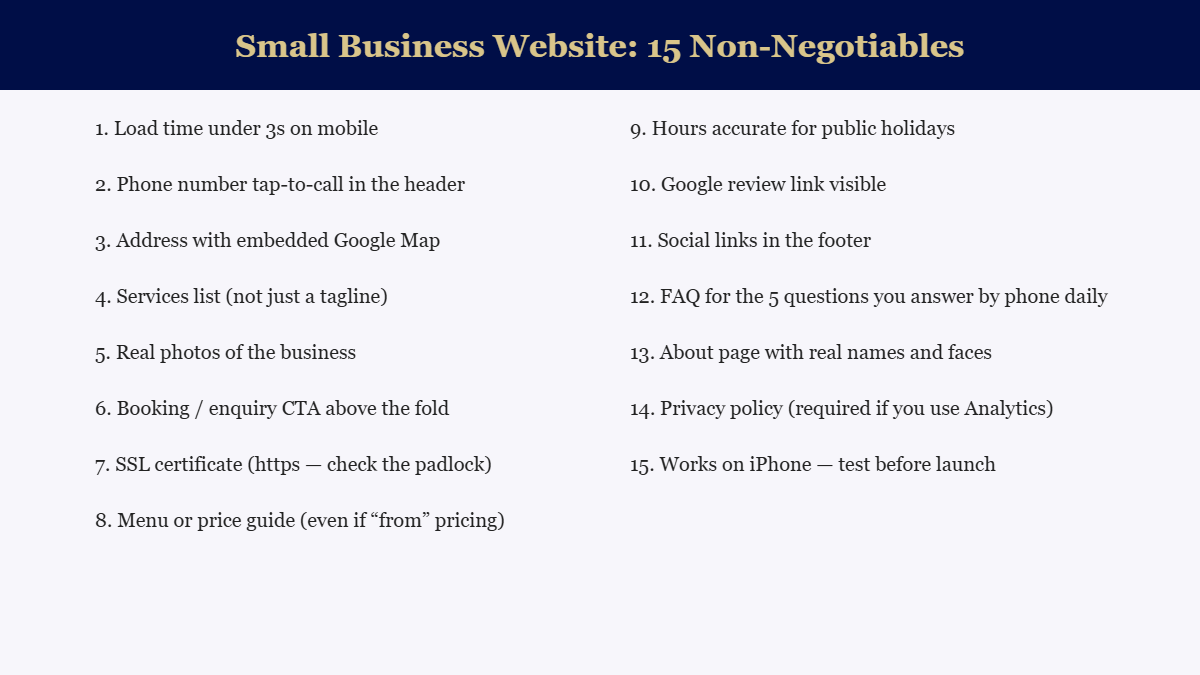
The three that cause the most lost business when missing: number two (the tap-to-call in the header — mobile users who can’t call in one tap leave), number eight (pricing information — visitors who can’t estimate the cost before enquiring have a much higher exit rate), and number nine (public holiday hours — the single most Googled attribute of a local business in December).
Mobile-first: the one test that matters most
More than 70% of local business website visits arrive on a phone. Run this test right now: pull up your website on your phone, on the phone you actually use, not on the desktop. Does the phone number appear in the first screen without scrolling? Is the text readable without zooming? Does the menu open and work without frustration? Can you book, enquire or find the address without going back to Google? If any of these fail, your site is losing mobile visitors at the point of highest intent. These are the people who found you while standing near your business or deciding where to go that night. The fix is usually not a rebuild — it’s a settings change or a theme adjustment that takes an hour. Our web design team does a mobile audit as the first step of any engagement.
Speed: the silent conversion killer
Google’s data shows that mobile bounce rate increases significantly for every additional second of load time beyond two seconds. A local business site that takes five seconds to load on a 4G connection is converting at roughly half the rate it would at two seconds — not from bad content, but from impatience. The causes of slow sites are usually fixable without rebuilding: uncompressed images (the most common), no caching plugin, shared hosting that’s underpowered, or a page builder loading unnecessary CSS. Run your URL through Google’s PageSpeed Insights and address the top three issues. The “Largest Contentful Paint” score is the metric that correlates most directly with conversions for local business sites.
Trust signals: what makes a stranger feel safe
A local business website visitor who doesn’t already know you is subconsciously running a trust audit. The signals that pass it: real photos of the actual business (not stock), real names and faces on the about page, a physical address, a Google review widget showing genuine reviews, and an ABN or professional association membership if relevant. The signals that fail it: a generic stock photo on the homepage, no pricing information whatsoever, a contact form with no email or phone alternative, and SSL missing. Trust signals are not decoration — they are conversion infrastructure. A site that looks like a real local business run by real people converts enquiries at two to three times the rate of a site that looks like a template someone filled in.
Local signals: the SEO layer most sites skip
The checklist above gets the site converting. Adding local SEO signals to the same pages gets the site found. The minimum local layer: your suburb name in the page title, H1 and opening paragraph of the homepage; a Google Map embed showing your actual address; an embedded review widget or schema markup pointing to your Google reviews; and one service-plus-suburb page for your primary offering (“Videographer Brisbane,” “Butcher Shop Paddington,” “Restaurant New Farm”). Combined with a complete GBP, these elements close the loop between search and conversion — the site ranks for local queries, and when visitors arrive, it converts them. This two-layer design is the foundation of every site we build at AceAds. Book a free consultation or call 07 2142 4335 for a web audit.
← Explore all our Brisbane marketing guides
Frequently asked questions
How much does a small business website cost in Australia?
Simple brochure sites from a freelancer start around $1,500–3,000. Professional custom builds with booking, e-commerce or content management run $3,000–8,000+. The price range is wide because scope is wide: a five-page service site and a fifty-page e-commerce store are both “small business websites.” Define the scope before getting quotes, and weigh build cost against ongoing hosting and maintenance.
What platform should a small business use for their website?
WordPress with a quality theme is the most flexible and widely supported choice for local businesses — it handles everything from a simple five-page site to a WooCommerce store, and is what most local SEO and web developers work with. Squarespace and Wix are faster to launch for very simple sites but have less flexibility and portability long-term. Shopify is the best choice if e-commerce is the primary purpose.
Do small businesses need SSL certificates?
Yes. HTTPS (indicated by the padlock) is a baseline expectation for any business website in 2026 — Google marks HTTP sites as “not secure” in Chrome, which immediately reduces trust with any visitor who notices. Most hosting providers include a free SSL certificate; if yours doesn’t, switch or add one.
How often should a small business update their website?
The pages that need active management: hours (check quarterly and before every public holiday season), services and pricing (whenever they change), photos (refresh annually at minimum), and the blog if you run one. The structural pages — about, services, contact — need less frequent updating but should be reviewed annually for accuracy.