
Videography vs DIY Phone Video: When to Hire a Pro in Brisbane
Here’s something you don’t expect a video production company to say: a lot of the video your business needs should be shot on your phone. The modern phone is a genuinely good camera, and “authentic and today” often beats “polished and next week.” The expensive mistake isn’t choosing DIY or choosing a pro — it’s using each one for the other’s job. This guide draws the line honestly: what phones now do brilliantly, exactly where they fall apart, and the maths that decides when hiring a Brisbane videographer pays for itself.
What’s in this guide
- What phones genuinely do well now
- The four places DIY breaks (audio first)
- Five questions that decide it
- Cost per asset: the math owners skip
- The hybrid system smart businesses run
- If you do hire: how to brief for the video you imagined
- The gear trap
- Choosing a videographer: red flags
- Frequently asked questions
What phones genuinely do well now
In good daylight, held steady, for subjects within a few metres — a phone is superb. That covers a surprising amount of business content: stories from the floor, behind-the-scenes process, quick reactive posts, staff moments, “just arrived” teasers. This content benefits from looking immediate rather than produced; audiences read the rawness as honesty. If your entire video presence today is nothing, a phone habit beats a quarterly production every time. Start there, guilt-free.
The four places DIY breaks (audio first)
Audio. Viewers forgive soft images long before they forgive bad sound. Echoey rooms, wind, aircon hum — the phone’s tiny microphones capture it all, and no caption fixes it. Low light. Interiors, dusk, venues at night: this is where small sensors visibly give up, smearing detail into noise. Stability and coverage. One handheld angle gets exhausting to watch; professional work is built from planned coverage — wides, details, movement — that a solo owner mid-service simply can’t capture. The edit. Filming is a third of the job; the hours disappear in cutting, colour, music licensing and export sizes, which is precisely the part owners abandon by week three.
Five questions that decide it

The second question deserves emphasis: the moment ad spend touches a video, production quality becomes a financial variable. Paid distribution amplifies whatever you give it — including shaky footage and muddy audio — and the algorithm’s delivery cost quietly punishes creative people skip. A modest ad budget behind professional creative routinely outperforms a bigger budget behind a phone clip; we see it in managed campaigns constantly.
Cost per asset: the math owners skip
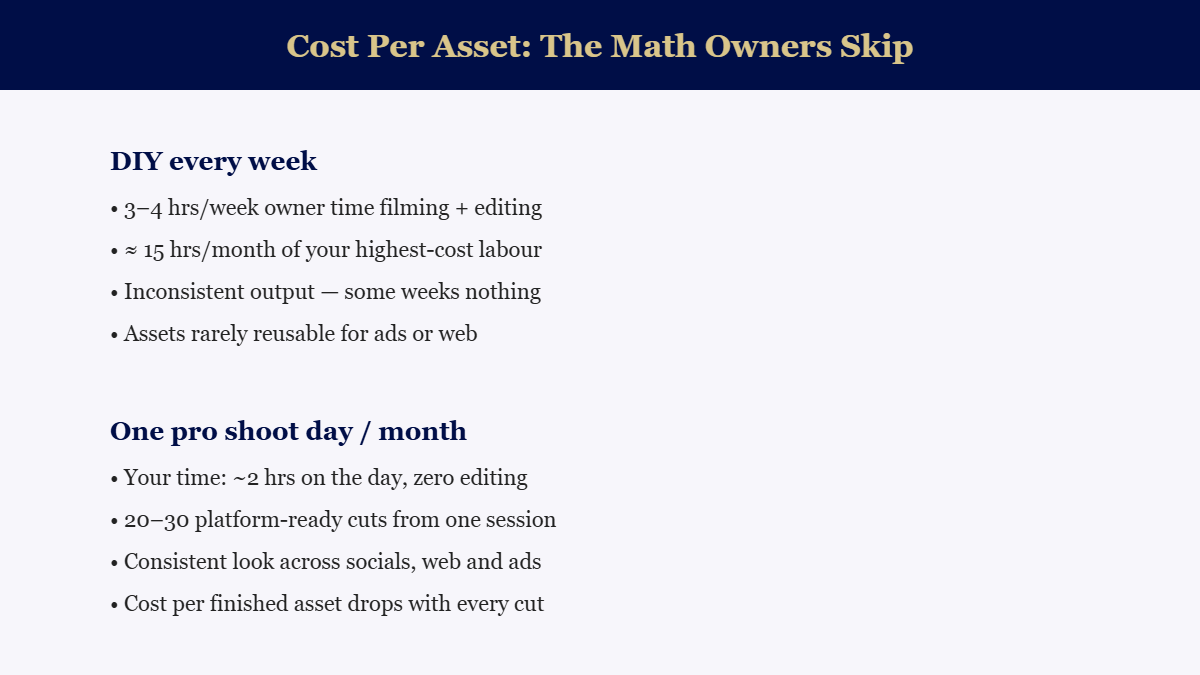
The DIY invoice is invisible because it’s paid in owner-hours — the most expensive labour in the business — spread across weeks. Batching flips the equation: one planned shoot day produces a hero film plus twenty-odd platform-ready cuts, so the per-asset cost falls with every deliverable, and the owner’s involvement compresses to a couple of hours. That’s the mechanism behind every “one day of filming, a month of content” promise, including ours.
The hybrid system smart businesses run
The businesses getting video right in Brisbane almost all run the same two-layer system. Layer one, DIY daily: stories, moments, replies — immediate, imperfect, constant. Layer two, pro monthly or quarterly: the batched session that produces the durable assets — website films, ad creative, the polished reels that anchor the grid. The layers feed each other: professional footage raises the perceived quality of everything around it, and daily DIY keeps the account alive between sessions. Our social media clients run exactly this split — we handle layer two and the posting; their team keeps layer one human.
If you do hire: how to brief for the video you imagined
Most disappointment in commissioned video traces back to a missing brief, not a bad videographer. One page fixes it: the job (win listings? fill Tuesdays? explain a service?), the destination (website hero, Instagram, ads — each changes format and length), who appears and whether they need coaxing, and three links you like with a word on why. From that, a good crew builds the shot list and you approve it before anyone presses record — which is the moment the final edit is actually decided. Bring that page to a free consultation or call 07 2142 4335, and you’ll get a straight answer on whether your idea even needs a pro — sometimes ours is “your phone can do this one.”
The gear trap: why buying a camera isn’t the third option
There’s a tempting middle path owners reach for: skip both the phone and the pro, buy a “real camera,” and level up in-house. It almost never works, and the reason isn’t the camera — it’s that the camera was never the constraint. Lighting knowledge, audio capture, coverage planning and edit hours were the constraint, and a mirrorless body solves none of them while adding menus, lenses, storage and a learning curve paid in owner time. Within six months the camera lives in a drawer and the business is back to phone clips, now with two thousand dollars less. If the appetite for in-house exists, spend it on training one keen staff member in phone technique and lighting basics — the returns are faster and the tool is already in their pocket.
Choosing a videographer: three red flags and one green one
Red flags: a portfolio full of one industry when yours is different (styles don’t always transfer), no questions about where the video will run (a website hero and a TikTok are different products), and vagueness about music licensing for paid use — the compliance detail that bites hardest later. The green flag: they push back on something in your brief. A crew that says “actually, for that goal you’d be better off with X” is thinking about your outcome, not their invoice — and that’s the working relationship that produces video worth paying for.
← Explore all our Brisbane marketing guides
Frequently asked questions
How much does it cost to hire a videographer in Brisbane?
It depends entirely on the brief — shoot length, locations, deliverables and editing complexity. As a reference point, our real estate listing packages that include video start from $750 (currently half price for first-time agents); brand and venue productions are quoted per brief after a free consultation.
Is phone video ever good enough for a business?
Absolutely — for stories, behind-the-scenes moments and timely reactive content, a steady phone in good light is not just acceptable but often preferable. The line is durability: anything living longer than a week, carrying ad spend, or representing a premium price point deserves professional production.
What should I prepare before a professional shoot?
A one-page brief: the goal of the video, where it will run, who appears, and three examples you like. Good videographers turn that into a shot list — and a clear brief is the single biggest factor in loving the final edit.
How many videos come out of one shoot day?
With batching, one day typically yields a hero video plus 20–30 short cuts sized for Instagram, TikTok, YouTube and ads — enough to fuel about a month of posting.