
Google Ads vs Meta Ads for Local Businesses: Where to Start
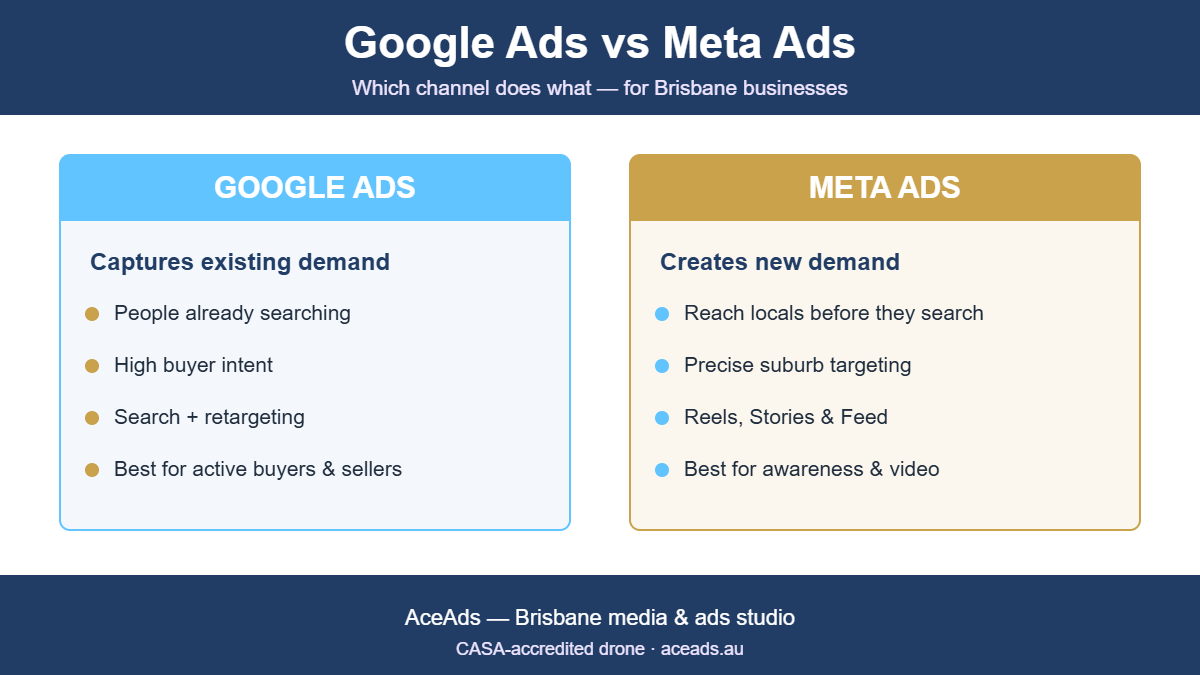
Every Brisbane small business owner with a marketing budget eventually faces the same question: Google or Facebook? The framing is wrong — they’re not alternatives, they serve different stages of the same customer journey — but the sequencing question is legitimate. If you can only fund one channel first, or only one channel fits your category right now, the answer comes down to a single diagnostic: do your customers search for what you sell, or do they discover it? This guide maps the answer to your business type, explains what each channel actually does, and tells you when to run both.
What’s in this guide
- The intent-stage model: how to choose
- Google Ads: capturing existing demand
- Meta Ads: creating new demand
- Why local businesses need both eventually
- Creative: the variable that matters more than budget
- What to measure in each channel
- Frequently asked questions
The intent-stage model: how to choose
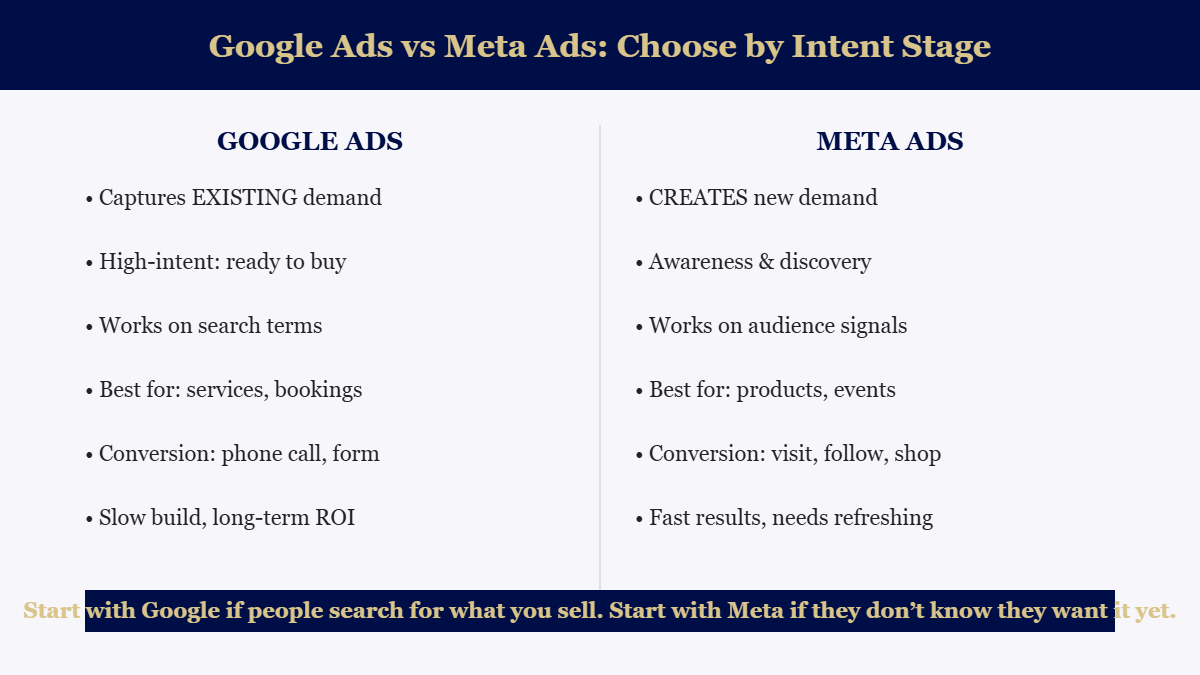
Two questions decide the first channel. Are your customers actively searching for this? — someone typing “plumber Newstead” or “butcher near me” has defined intent; Google captures it. Is your product something people discover and then want? — a new restaurant concept, a jewellery brand, a venue event; Meta creates the discovery. Most businesses have elements of both: a restaurant is discovered on Meta and searched on Google (“is [restaurant] open tonight?”). The one to fund first is the channel that sits closest to your current revenue constraint. If you’re missing bookings you could convert, Google. If you’re not generating enough awareness to have bookings to convert, Meta.
Google Ads: capturing existing demand
Google Search Ads appear when someone types a search term that matches your keywords — which means you’re paying to intercept demand that already exists. The Brisbane categories where this works immediately: trades and services, professional services, local retail with specific product searches, restaurants when people are searching for a table tonight. The key to performance is specificity: keywords like “butcher shop Paddington Brisbane” convert at a higher rate and lower cost-per-click than broad terms like “butcher.” Your landing page needs to match the search intent exactly — someone searching for a plumber needs a phone number above the fold, not a homepage carousel. We build landing pages to this standard as part of our managed ads service.
Meta Ads: creating new demand
Meta (Facebook + Instagram) ads don’t intercept searches — they appear in front of people who match an audience definition while they’re doing something else. The upside: you can reach people who don’t know they want what you sell yet. The downside: the creative has to earn attention that wasn’t voluntarily given. This is why video outperforms static images on Meta by a significant margin for most local businesses — it stops the scroll and establishes context before the viewer decides to engage. For restaurants, venues, jewellery and lifestyle brands, Meta’s creative-driven discovery format is the primary channel; for trades and professional services where the need triggers a search, it’s a supporting channel. Our in-house video production exists precisely because Meta ads run on creative, and creative runs on footage.
Why local businesses need both eventually
The full-funnel argument: Meta introduces a potential customer to your brand at the awareness stage; they see your restaurant reel, save it, and forget to book. Three weeks later they’re searching “restaurants West End” on Google and your Search Ad appears. The conversion on that click is higher than it would have been without the prior Meta exposure — because they already know who you are. This brand-awareness lift from Meta improving Google’s conversion rate is real and measurable over time, which is why integrated campaigns outperform single-channel spending at the same total budget once a business is ready to fund both.
Creative: the variable that matters more than budget
On Meta, two ads with identical budgets targeting identical audiences can perform five to ten times differently based solely on the creative. A fifteen-second reel of your actual product or venue, shot professionally, will consistently outperform a designed graphic at the same spend. On Google, the equivalent variable is the match between keyword, ad copy and landing page — a specific ad for a specific term pointing at a specific page converts better than a generic ad pointing at a homepage. In both channels, the return on optimising the creative or the landing page is higher than the return on increasing the budget. Start with the quality; then scale the spend.
What to measure in each channel
Google: cost-per-click, conversion rate from click to enquiry or booking, and cost-per-conversion. If your cost-per-conversion is below what the customer is worth to you, scale. Meta: cost-per-thousand impressions (CPM) tells you the audience efficiency; link click-through rate tells you the creative efficiency; cost-per-result (lead, purchase, booking) tells you the business efficiency. Watch all three and you’ll know whether the problem is audience targeting, creative or landing page when performance drops. Book a free consultation or call 07 2142 4335 for a channel strategy specific to your business.
Local targeting: the settings most businesses get wrong
Most local Brisbane businesses set their ads to target “Queensland” or “Australia.” This wastes the majority of the budget on people who can’t walk in, drive over or book on the same day. The correct targeting for a local service or venue is a radius around your address — typically 5–15 km depending on category and car-dependency — or specific postcode targeting for highly local businesses like butchers and restaurants. On Meta, add an interest layer (food, local events, your specific category) on top of the geographic radius; on Google, use location extensions so the address and phone number appear in the ad. Both platforms allow you to exclude areas where you can’t serve, which improves the efficiency of every dollar spent.
← Explore all our Brisbane marketing guides
Want it managed for you? See our Google & Meta Ads management in Brisbane.
Frequently asked questions
Should I start with Google Ads or Facebook Ads?
Ask whether your customers are actively searching for what you sell. If someone in Brisbane types “butcher near me” or “mobile mechanic Paddington,” Google Search captures that intent directly. If your product is something people discover and then decide they want — a new restaurant, an event, a jewellery brand — Meta is more effective at the awareness stage. Most local businesses need both eventually; the question is which one to fund first with a limited budget.
How much should a local Brisbane business spend on Google Ads?
The right starting budget depends on the cost-per-click in your category and suburb. Competitive service categories in Brisbane inner suburbs can run $5–15 per click; less competitive categories much less. We recommend starting with enough budget to generate twenty to thirty clicks per week — that’s sufficient data to optimise from. Exact budget recommendation comes from keyword research specific to your business, which we cover in the free consultation.
What is a good return on ad spend for local Meta ads?
For local Brisbane businesses with clear conversion goals (bookings, enquiries, purchases), a healthy ROAS is three to five times the ad spend for e-commerce products, and cost-per-lead below your average order value or lifetime value threshold for service businesses. These benchmarks vary significantly by industry and creative quality — the creative matters more than the budget in Meta’s auction.
Can you run Google Ads and Meta Ads at the same time?
Yes, and they often work better together than either alone. Google captures people searching right now; Meta keeps your brand visible while they’re not searching, and retargets people who visited your site from Google but didn’t convert. The two channels complement each other across the customer journey.