
How to Film in a Dark Venue (And Make the Crowd Look Incredible)
The gap between nightclub footage that makes a room look alive and footage that makes it look like a poorly lit car park is almost entirely technical — camera settings, lenses and an understanding of how to work with artificial lighting rather than fight it. This guide is for anyone briefing a videographer on a venue shoot, for venue managers evaluating what to expect, and for the videographers themselves who are picking up a dark-venue brief for the first time. The goal is footage that makes the people in the room look like they’re having the time of their life, because that footage sells the next event.
What’s in this guide
- Why dark venues are technically difficult
- Camera settings guide
- Lens choice
- Working with strobes and LED rigs
- The shot list for a great aftermovie
- Filming crowds: consent and best practice in Queensland
- Frequently asked questions
Why dark venues are technically difficult
Three technical challenges compound in a dark venue. Low and moving light: the exposure that works when the DJ booth is lit is wrong five seconds later when the laser sweeps across the room. Mixed colour temperatures: blue LED wash, amber spot, green laser and white strobe all appear in the same frame; auto white balance can’t handle this and produces clips that colour-shift mid-shot. Moving subjects: a crowd in motion needs a fast enough shutter to render cleanly at high ISO — and high ISO introduces noise that requires post-production recovery. Understanding all three is what separates footage worth using from footage you bin the next morning.
Camera settings guide
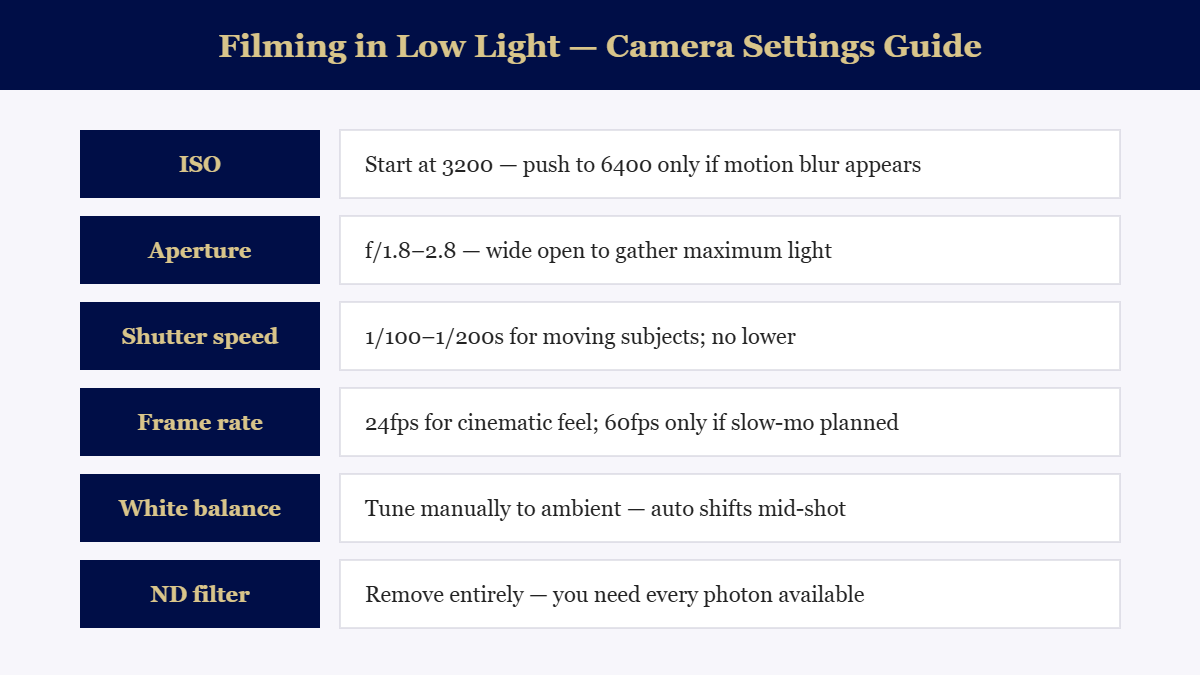
The settings above apply to mirrorless and DSLR cameras with full-frame or APS-C sensors. Smaller sensors require lower ISO ceilings before noise becomes unusable — test the maximum clean ISO for your specific camera before the night, not during it. Noise reduction applied in post (DaVinci Resolve’s NR, or Neat Video) can recover two to three stops of apparent noise from well-exposed footage; underexposed footage with noise is far harder to recover than properly exposed footage with grain.
Lens choice
A fast prime in the 24–50mm range is the standard toolkit for dark-venue work. The 50mm f/1.8 is the workhorse: long enough to compress the crowd slightly (which makes it look denser and more energetic), fast enough to gather real light. The 35mm f/1.4 is the go-to for showing the room as a whole — DJ, crowd, ceiling lights in one frame. The 85mm f/1.4 is for isolating faces and moments of genuine emotion from the crowd without a camera in their face. Bring all three if possible; the edit is richer when the footage has genuine variety of perspective.
Working with strobes and LED rigs
The common mistake with strobe-heavy rooms is trying to expose for the bright moments and then recovering the dark ones in post. The correct approach is the opposite: expose for the dark ambient baseline, and let the strobes clip to white occasionally — that’s how it looks to the eye, and the footage feels authentic. Consistently blown highlights look like technical failure; occasional brightness peaks look like an energetic room. For multi-coloured LED rigs, set the white balance to 4500K as a neutral starting point and fine-tune in the first few minutes of the night before the full rig is running. Shoot LOG or C-LOG if your camera supports it for maximum colour recovery latitude in the edit.
The shot list for a great aftermovie
A one-night shoot that covers these categories produces a complete aftermovie without needing anything else: crowd energy shots (faces at the drop, crowd singalong, queue forming), DJ or artist performance (wide establishing, mid close on hands and equipment, tight on face during peak moments), venue atmosphere (bar at speed, lighting rig overhead, queue outside in the hour before entry), guest moments (candid groups, not posed photos — the genuine interactions), and transitions and details (the stamp on the wrist, the drink poured, the monitor waveform). These five categories, captured continuously through a night, give the editor enough material to build a genuine narrative. For professionally captured versions of all five, see how we handle venue shoot nights.
Filming crowds: consent and best practice in Queensland
In a public-facing licensed venue, general crowd filming during a public event doesn’t require individual patron release forms, provided the event is clearly publicised as filmed (ticketing language, signage at entry, announcements). This is the standard in Queensland under current privacy and surveillance guidelines for commercial entertainment filming. Individual interviews, named features or any footage specifically identifying a patron in a context that could be embarrassing or reputationally damaging should have a signed release. The practical standard: film the energy of the room, not the individual on their worst behaviour. That’s both the ethical and the legally sensible approach, and it also happens to produce better footage — crowd energy is more compelling than individual close-ups. Book a consultation or call 07 2142 4335 to discuss venue shoot coverage.
Venue marketing channels
| Channel | Best for |
|---|---|
| Event content & aftermovies | Selling the next event |
| Social calendar | Consistent weekly reach |
| Geo-targeted ads | Right postcodes, right night |
| Artist cross-promotion | Borrowing new audiences |
| Reviews & UGC | Trust and word of mouth |
← Explore all our Brisbane marketing guides
Frequently asked questions
What camera settings work best for nightclub videography?
The guiding principle is maximum light without motion blur. Wide aperture (f/1.8–2.8), ISO 3200–6400 depending on the scene, and shutter speed no slower than 1/100s for moving subjects. Frame rate 24fps for cinematic feel unless slow-motion clips are planned. Manual white balance set to match the dominant light source — never auto, which shifts mid-clip as lighting changes.
What lens is best for filming in a dark venue?
A fast prime — 50mm f/1.8 or 35mm f/1.4 — is the standard choice. The wide aperture gathers more light than any zoom can match at equivalent focal lengths. For a wider environmental shot showing the crowd and room together, a 24mm f/1.4 is the go-to. Zooms are useful for outdoor events; in a controlled dark venue, primes win on image quality and light-gathering.
How do you handle strobes and LED lighting on the dancefloor?
Strobe lights can confuse autofocus and exposure systems. Use manual focus on a pre-determined zone (where the DJ or crowd focus is) and manual exposure. Shoot a test clip, check the highlight detail on the LCD, and lock settings before the night starts. In-camera tools like zebra warnings help identify blown highlights from coloured LED rigs — worth enabling before arrival.
Do you need to add lighting in a dark venue?
For documentary coverage of a real night, no — and adding a video light usually destroys the atmosphere and makes the footage look like surveillance rather than a promo film. For interview segments or piece-to-cameras at the venue, a small battery-powered LED panel with a diffusion dome adds fill without disrupting the space. The rule: if the light you’re adding would be noticed by a regular patron, it’s too much.