
How Fast Food Shops Win the “Near Me” Search
When someone types “burgers near me” or “cheap lunch Brisbane CBD,” the map pack decides where they spend the next thirty minutes. Three signals determine who’s in it: proximity (where you are), relevance (whether Google thinks you match the query), and prominence (whether enough people have publicly endorsed you). The first is fixed by your address. The second and third are completely within your control — and most fast food shops in Brisbane have left both half-built. This guide is the fix.
What’s in this guide
- The three Google signals for near-me searches
- GBP: the relevance levers
- The review engine: building prominence systematically
- The website’s role in the near-me journey
- Menu on Google: the field most shops skip
- Competing against big chains in your suburb
- Frequently asked questions
The three Google signals for near-me searches
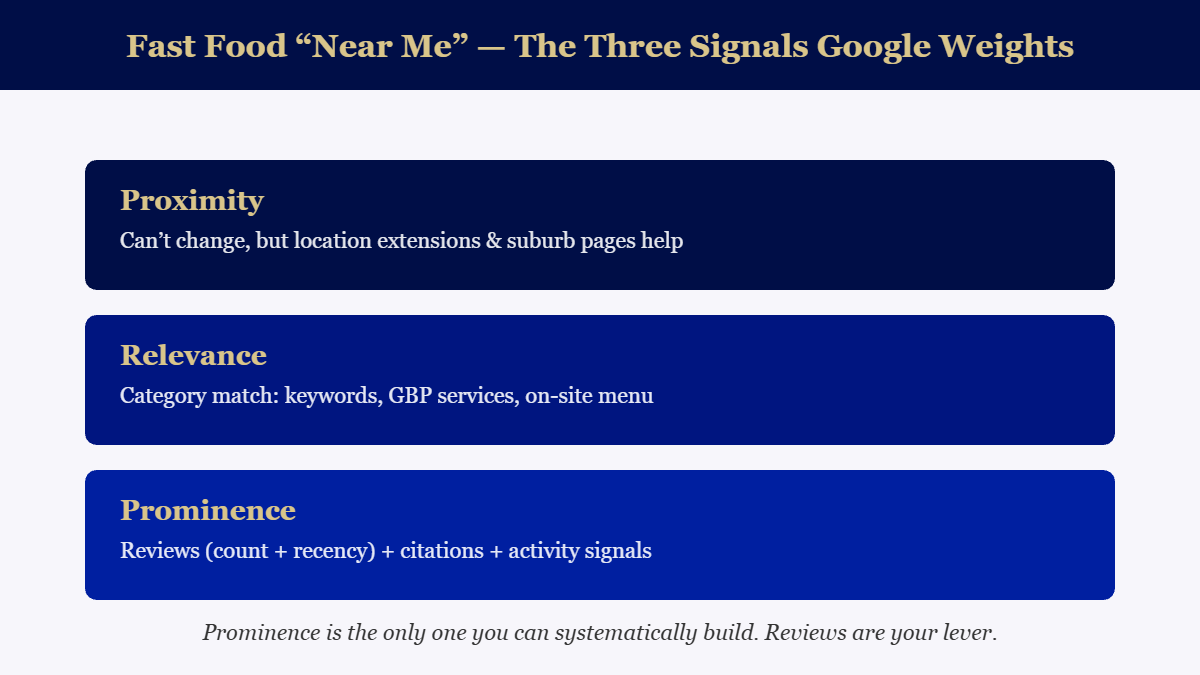
Near-me intent is the most commercially valuable local search because the decision window is minutes, not days. The customer is hungry now, in your suburb, and the map pack result they tap is usually where they go. Most fast food shops are in the map pack already — the question is whether you’re in the top three, which captures the majority of clicks, or in the buried six-plus below.
GBP: the relevance levers
Relevance is the signal most shops under-invest in. The primary category must match the search term — “Burger Restaurant” or “Fast Food Restaurant” rather than a vague general option. Add secondary categories for every cuisine or format you offer. Fill the service list with every item a customer might search for (“chicken burgers,” “vegan options,” “late-night food”). Write a description that includes the suburb name and your most-searched items. Upload photos with file names that describe the dish, not “IMG_4823.jpg.” Each of these is a relevance signal that helps Google match your listing to queries your category covers. Our local SEO service builds this as the first layer for every food client.
The review engine: building prominence systematically
In a suburb with multiple fast food options at similar price points, the business with more recent, high-volume reviews wins the map pack position above the one with fewer. This isn’t a small effect — it’s often the difference between position one and position four, which in a near-me map pack is the difference between most clicks and almost none. The system: a QR code on every counter, tray liner or bag that links directly to the Google review page (one tap, not a search), staff trained to mention it when the interaction goes well (“if you enjoyed it, a quick review really helps us”), and every review replied to within 24 hours. A response to a negative review that’s calm and solution-focused is read by more people than the negative review itself — and it consistently reduces the reputational impact.
The website’s role in the near-me journey
The near-me click usually goes to GBP first, then the website link for the menu and order confirmation. A site that loads slowly, requires a PDF download for the menu, or doesn’t have an obvious order button loses customers at this stage — after GBP has done its job. The website minimum for fast food: current menu with prices (not a PDF), one-tap phone number, clearly stated hours, and an order link that goes to your direct ordering system rather than a marketplace that takes commission. Our web builds for food businesses ship with this flow by default.
Menu on Google: the field most shops skip
Google allows fast food businesses to upload a menu directly to their GBP — either via a supported ordering partner or by manually adding menu sections and items. A menu on GBP lets customers see your dishes and prices in the Knowledge Panel without visiting the website, which reduces the steps to a walk-in decision. It also provides Google with item-level data that improves your relevance for dish-specific searches (“chicken schnitzel near me” rather than just “fast food near me”). Most competitors in your suburb haven’t done this. It takes an hour to set up and stays updated whenever your menu changes.
Competing against big chains in your suburb
National chains have SEO resources independents don’t, but the map pack has a strong proximity weighting — which means a local independent directly beside where the search happens can and does outrank a chain that’s two suburbs over. The compound advantage of a complete GBP, higher review velocity, faster response rates and local content that chains can’t produce (named staff, genuine suburb references, real community involvement) compounds over twelve to eighteen months. Chains also can’t easily personalise their GBP at the individual location level — which means a responsive, active independent profile consistently outperforms a neglected chain outpost in the same area, even from a worse starting position. Book a free consultation or call 07 2142 4335 for a local SEO review.
Page speed: the near-me conversion killer
A customer who tapped your GBP link on their phone while standing two blocks away will wait approximately three seconds for your site to load. Beyond that, they’re back in the map pack clicking your competitor. Google’s PageSpeed Insights score for mobile is a direct proxy for this drop-off — a score below 50 on mobile is a conversion problem, not just a technical metric. The three fastest wins: compress your menu images to under 100KB each, enable caching via your hosting provider’s panel, and switch to a hosting plan that’s genuinely fast (many restaurant sites sit on shared hosting that’s fine for traffic but slow for first-byte response). All three are covered in a standard technical SEO audit and can usually be actioned in under an hour.
← Explore all our Brisbane marketing guides
Want this handled for your venue? See our restaurant photography & video packages in Brisbane — from $140.
Frequently asked questions
How do fast food shops rank for “near me” searches?
The three signals are proximity, relevance and prominence. Proximity is fixed by your address. Relevance comes from a complete, keyword-rich GBP with the right primary category, your menu listed, and on-site content that matches search terms. Prominence — the one you can build — comes from review count and recency, NAP-consistent citations, and the activity signals of a managed GBP profile.
Do fast food shops need a website to rank locally?
GBP alone can win the map pack, but the organic results below it — and the full customer journey from “near me” to order confirmation — requires a website. A fast, mobile-friendly site with the menu, hours and an order link is the minimum. Without it, you’re winning the discovery and losing the conversion.
How many Google reviews does a fast food shop need?
Enough to be credible relative to your direct competitors in the same suburb. In Brisbane’s suburbs, most fast food operations have between 50 and 500 reviews; being in the top third for volume in your specific trade area is more important than hitting any absolute number. Recency matters as much as count — consistent new reviews signal an active business.
Can paid ads help a fast food shop win more near me traffic?
Google Ads with location extensions can get your shop into paid results above the map pack for near-me queries, which is valuable during launch or for competitive suburbs. Long-term, organic GBP and review velocity is more cost-efficient than paying for every click. The two approaches are complementary — ads for the short-term spike, GBP for the sustained floor.