
Farm-to-Table Storytelling: Videos That Justify Premium Cuts
The supermarket sells beef. Your shop sells the grain-fed Darling Downs yearling that arrived Tuesday morning, broken down by someone who’s been cutting meat for fifteen years. Those are different products — but only if the customer knows the difference. Farm-to-table storytelling is the bridge between the quality you source and the price you charge, and in 2026 it’s almost entirely a video discipline: sixty seconds from delivery to counter, filmed on a phone, posted before lunch. This guide shows you the arc, the shots and the habit that makes it compound.
What’s in this guide
- Why provenance justifies the price tag
- The five-part story arc
- The shots to film (and when)
- Your voice is the differentiator
- When to upgrade from phone to professional
- The weekly habit: 15 minutes that compounds
- Frequently asked questions
Why provenance justifies the price tag
A customer in a supermarket sees a tray with a sticker. A customer at your counter sees a person who can tell them the animal, the region, the method and the honest cooking advice. That information converts uncertainty into confidence, and confidence is what premium prices run on. Farm-to-table storytelling makes this dynamic visible to people who haven’t walked into your shop yet — the Instagram viewer who doesn’t know you exist but sees a sixty-second video of a named-farm delivery and hears a butcher who clearly knows what they’re talking about. That video is doing the same work as the counter conversation, at scale, for free.
The five-part story arc
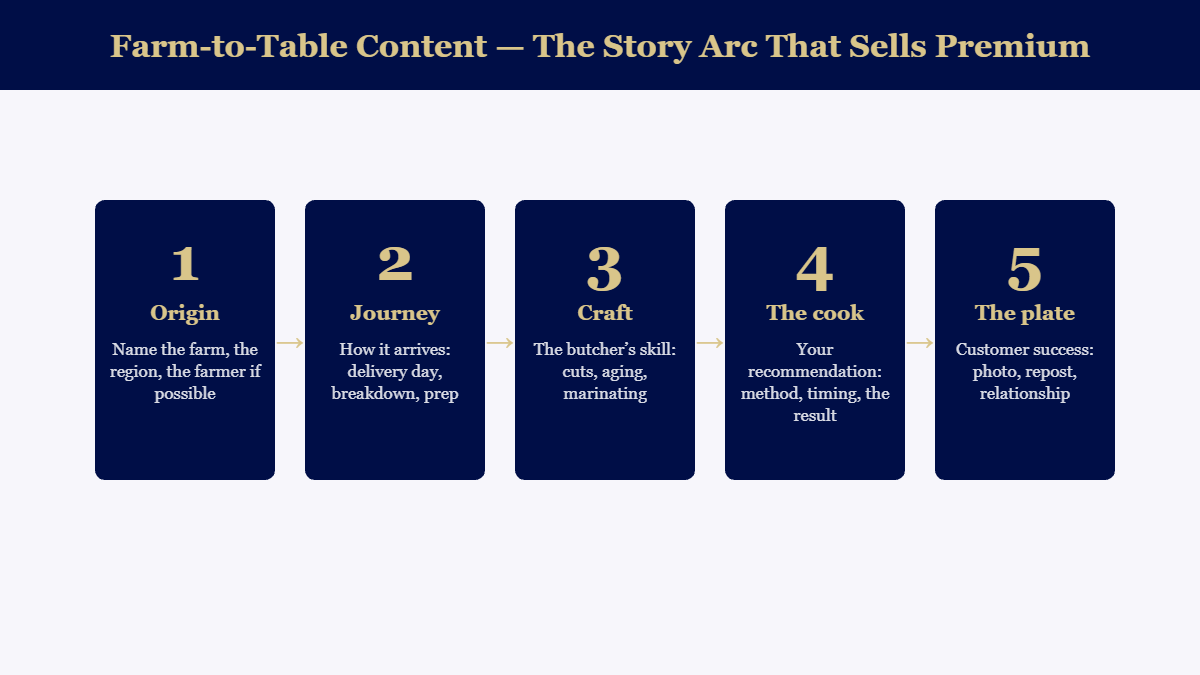
Not every piece of content needs all five steps — the arc is a library you draw from. A Monday delivery post is step one. A Wednesday cutting video is step three. A Sunday recipe repost from a customer is step five. Together, across a week, they tell a complete story without any single post feeling forced or over-produced. The provenance claim (step one) is the most important because it’s the one the supermarket can’t replicate — make it specific every time.
The shots to film (and when)
Delivery morning (steps 1–2): the boxes arriving with the supplier’s name visible, the walk-in door, the first whole cuts coming out. Thirty seconds of phone footage, shot before the shop opens. Prep and breakdown (step 3): hands working — boning, rolling, tying. The craft is the content; you don’t need to narrate if the skill speaks for itself. Counter display (step 3–4): the finished cuts laid out, with a to-camera recommendation about the best cooking method. Sixty seconds, no script needed. Customer result (step 5): repost it when a customer tags you in a finished plate, with a genuine comment about the cut. This costs nothing and closes the story loop for every future customer who sees the thread.
Your voice is the differentiator
The most-watched butcher content on social media in Australia is not the most polished — it’s the most specific and honest. A thirty-second video of a butcher saying “this is the Kilcoy Gold wagyu I was waiting three weeks for, MB6+, I’d sous vide it at 54° for two hours then a hard sear” is watched, saved and shared because it’s genuinely useful and clearly expert. No set, no lighting rig, no script — just knowledge delivered directly. Your counter conversation, filmed. The first five of these feel uncomfortable; by the tenth, customers will be asking when the next one goes up.
When to upgrade from phone to professional
Phone content owns the daily provenance loop — delivery, cutting, counter. Professional photography and video earns its place twice a year: the range shoot that populates the online ordering page with product images that don’t look like crime scene evidence, and the brand film that captures what the shop actually feels like for the website and social bio. Both are covered in our butcher marketing services. The relationship between daily phone content and periodic professional sessions is the same hybrid our food and venue clients run: phone for frequency and authenticity, professional for the permanent assets.
The weekly habit: 15 minutes that compounds
Monday: film the delivery (5 min). Tuesday: film the cut-of-the-week with cooking advice (5 min). One of those becomes Wednesday’s post; the other goes Thursday or Friday. Sunday: repost the best customer plate of the week with a genuine comment. That’s the whole system — fifteen minutes spread across the week, no agency needed, and the content compounds because each post trains the algorithm to show the next one to the same local audience. After three months of this, the locals who buy from you have watched enough of your content that they feel like they know you — which is exactly the relationship the supermarket can never build at scale. Want the weekly shoot handled professionally? Book a consultation or call 07 2142 4335.
Seasonal provenance: four moments butchers should pre-plan
The farm-to-table story is especially powerful at seasonal moments when customers are planning meals in advance and willing to spend more. Pre-Christmas (October): ham and turkey provenance, pre-order content, behind-the-scenes curing and preparation. Australia Day – Easter (January–April): lamb provenance peak — name the breed, the region, the recommended cut for the occasion. Footy season (March–September): BBQ pack provenance and sausage storytelling (your recipe, your sourcing) — accessible content with high share rates. Mid-winter (June–August): slow-cook cuts — the story of a braising beef or a lamb shoulder is the best cooking advice content a butcher can post. Each window has its own provenance angle; planning them a month ahead means the content exists before the demand peaks, not after.
From content to community: when the story comes back to you
The compounding effect of consistent provenance storytelling is community formation — regulars who feel invested in the supply chain, who recommend the shop by name, who bring first-time buyers in saying “you have to ask about the Kilcoy wagyu.” That’s word-of-mouth with a specific content hook, which is the most durable form of local marketing available. The feedback loop to watch: when customers start using your supplier names unprompted at the counter, the storytelling has embedded. At that point, every new video you post reaches an audience that’s already sold — and every new customer they bring in arrives pre-educated about why your price is different from the supermarket’s.
← Explore all our Brisbane marketing guides
Want this handled for you? See our butcher shop photography & video in Brisbane — from $140.
Frequently asked questions
What is farm-to-table marketing for butchers?
It’s the practice of making the supply chain visible and human: naming the farm, showing the delivery, telling the story of how an animal was raised and how it arrives at your counter. The goal isn’t virtue-signalling — it’s justification. Customers will pay a premium for a product they understand and trust; provenance storytelling builds that trust faster than any discount.
Does farm-to-table content actually increase sales?
It increases the likelihood of selling premium cuts at premium prices, which is where butcher margins live. A named-farm wagyu sold with its story at full price serves the business better than commodity mince sold slightly below the supermarket. The content doesn’t create demand for quality; it removes the barrier to paying for it.
How do you film a delivery day without it looking boring?
Focus on specificity and character. The farmer’s name on the box. The butcher’s hands lifting a whole carcass. A thirty-second voice-note from you about what’s in this week and why it’s special. Ordinary delivery footage is boring; delivery footage with a story and a specific provenance claim is the most trusted content a butcher can post.
Do small butchers need to source sustainably to use this approach?
Honest provenance storytelling works even for conventional supply chains: a local abattoir, a Queensland feedlot, a reliable wholesale supplier. What matters is specificity and honesty — “Queensland grain-fed, 120 days” is a provenance story even if it’s not a heritage-breed farm. Never fabricate origin claims; that’s a regulatory and trust risk.