
One Shoot Day, One Month of Content: How Batching Works
The content hamster wheel — filming something today, posting it today, starting again tomorrow — is the most expensive way to run social media for a local business. Not just in time, but in quality and consistency. The alternative is batching: one planned shoot day per month that produces all the content your accounts need for four to five weeks, pre-scheduled and ready to post. This guide explains the model, what a well-structured shoot day actually produces, and how to brief for one.
What’s in this guide
- The economics of batching vs daily creation
- What one shoot day actually produces
- How to brief a shoot day
- Scheduling: spreading it out without it looking scheduled
- The hybrid: batched plus reactive
- Frequently asked questions
The economics of batching vs daily creation
An owner spending twenty minutes a day filming and editing spends roughly seven to eight hours a month on content — at their highest-cost labour rate, because it’s their time. The output is twenty to thirty low-production posts, many of which underperform because they were made under time pressure. One professional shoot day of two to four hours produces more output, at higher quality, with less disruption to the business day — and the per-asset cost drops as output scales. The economics work even more clearly for businesses with photogenic products or environments where professional lighting and composition move the needle on engagement rates.
What one shoot day actually produces
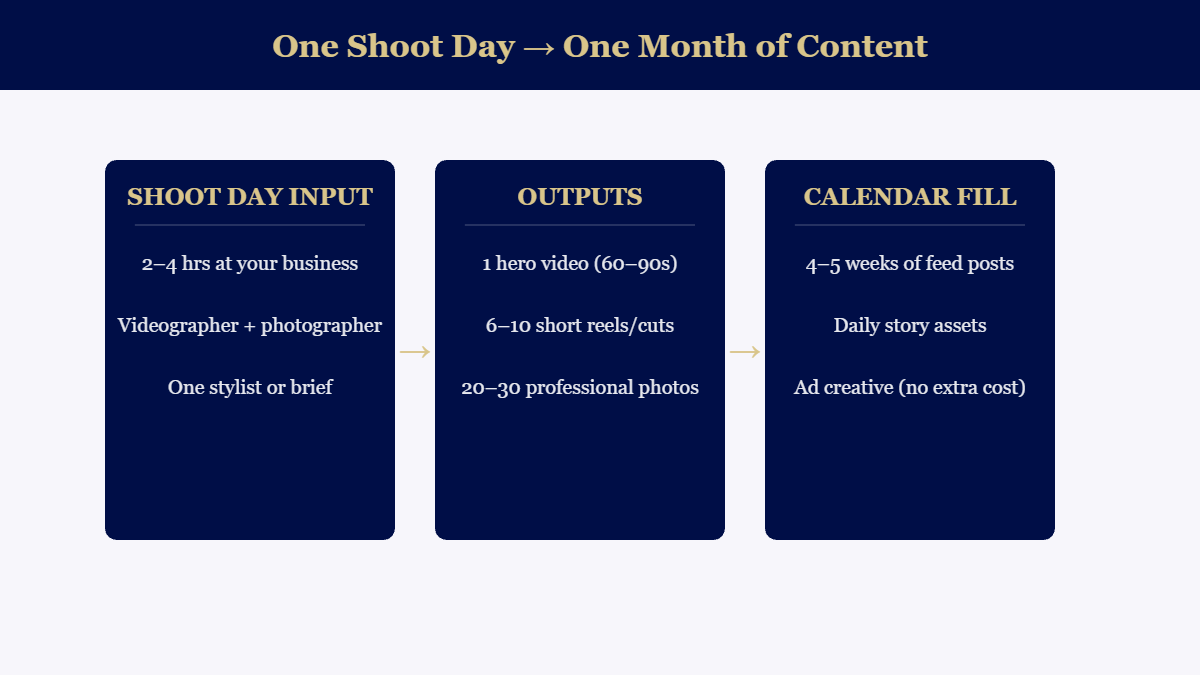
The specific outputs vary by industry but the structure is consistent. For a restaurant: a hero dish video, eight to ten individual dish reels, a kitchen and team montage, and thirty-plus food and atmosphere photos. For a butcher: a brand film, product shots of the full range, a cutting video, and twenty photos for the web store and social calendar. For a real estate agent: a listing walkthrough, a piece-to-camera, a suburb lifestyle reel and a set of stills. The shoot is briefed to produce all three categories simultaneously — hero, social cuts, static images — from the same session.
How to brief a shoot day
A good brief answers four questions: what is the business trying to achieve in the next four weeks? (a new product launch, a seasonal push, a brand awareness build), which platforms and formats are the priority? (Instagram Reels vertical, horizontal YouTube, static feed), what aesthetic and tone are you after? (three reference links, not a description), and what do you need that you’ve never had? (a hero video that works as an ad, a set of product images that don’t look like phone photos). With these four answers, a professional crew can build the shot list and produce the right output without improvising on the day. Book the brief call before the shoot date, not the morning of.
Scheduling: spreading it out without it looking scheduled
The risk of batching is that the content looks uniform if posted without variation. Three habits prevent it. First, vary the format in the posting order: reel, photo, reel, carousel — not three reels in a row from the same shoot angle. Second, intersperse phone content and story posts between the scheduled pieces to maintain the signal of daily activity. Third, hold back two or three pieces from each batch to use reactively — if something in your industry happens that’s relevant, you have polished content ready to pair with a timely caption. Instagram’s native scheduling handles the timing; the above structure handles the appearance of variety.
The hybrid: batched plus reactive
The highest-performing social media accounts in our client roster run a two-layer system. The batch provides the visual quality floor and the consistent rhythm — it’s the content that looks professional and positions the brand. The daily phone layer provides the human signal — stories from this morning’s delivery, a quick thought about a market trend, a candid staff moment. Together they look alive in a way that neither layer achieves alone. The ratio that works: batched content for three to four feed posts per week, phone-native for daily stories. The batch takes one planned day per month; the phone layer takes five minutes whenever something genuine is happening. Our social media management service runs exactly this split for every client: we handle the batch, the scheduling and the community management; the client or their team handles the authentic daily moments.
Ready to try one shoot day? Book a free consultation or call 07 2142 4335.
Building the monthly shoot into the business calendar
The shoot day that gets cancelled is the one that wasn’t protected. Book it on the first working day of each month, or the last week of each month for the following month’s content — choose the pattern that fits your rhythm and treat it as immovably as a supplier delivery. The most common failure mode is the reactive business that keeps pushing the shoot for something urgent, then reaches month four having posted three months of phone content and wondering why the social growth hasn’t come. The shoot is the compounding engine; urgency will always find a reason to delay it. Protecting the date is the whole discipline.
← Explore all our Brisbane marketing guides
Frequently asked questions
What is content batching for social media?
Batching is filming and editing several weeks’ worth of content in one planned session rather than creating new content daily. For businesses where the owner is also the subject, it eliminates the decision fatigue of “what do I post today” and replaces it with a quarterly or monthly production block. The result is consistent posting without the daily time drain.
How many pieces of content can you get from one shoot day?
A well-briefed professional shoot day typically yields: one hero video (60–90 seconds for the website and primary social), six to ten short-form cuts in vertical format for reels and stories, and twenty to thirty usable photographs across product, team and atmosphere categories. That’s enough to fill four to five weeks of daily posting on two platforms.
Is batching or daily content creation better for engagement?
Batching wins for consistency; daily creation wins for authenticity and reactivity. The sustainable answer for most businesses is a hybrid: batch the planned content (the polished reels, the product shots, the evergreen guides) once a month, and supplement with quick phone content for reactive moments and stories. The planned content provides consistency; the daily phone moments provide the human signal the algorithm rewards.
Can small businesses afford a monthly shoot day?
The economics work when you account for the alternative. A solo owner spending three hours a week on content is spending twelve-plus hours a month on a task that compounds poorly. A monthly shoot day of similar duration, handled by a professional crew, produces an order of magnitude more usable output. The cost comparison is output-per-hour, not invoice-per-month.