
Bar Marketing Ideas That Fix Empty Tuesday Nights
Friday nights forgive everything; Tuesday nights forgive nothing. A quiet midweek room isn’t just lost revenue — it’s rent, rostered staff and a vibe problem that photographs badly. But here’s what we’ve learned filming Brisbane venues: the bars that fixed their Tuesdays didn’t find a magic promotion. They picked one boring, repeatable format, committed to it for two months, and let content do the compounding. This is the playbook, including the formats, the flywheel and the traps.
What’s in this guide
- Why midweek is a habit problem, not a promo problem
- Five formats and the crowds they actually pull
- The Tuesday flywheel: content is the promotion
- The discount trap (and the offer that works instead)
- Free reach: hosts, musicians and industry nights
- The eight-week commitment (and when to quit)
- The staffing detail that decides it
- Stacking nights without splitting habits
- Frequently asked questions
Why midweek is a habit problem, not a promo problem
Nobody “discovers” a bar on a Tuesday. Midweek crowds are built from routine: the trivia team that books the same table, the after-work group that knows Wednesday means live music. One-off promotions can spike a night, but a spike teaches customers nothing about next Tuesday. The goal is a recurring reason — same night, same format, every week — because the habit is the product. Every tactic below serves that single idea.
Five formats and the crowds they actually pull

Two under-rated picks from that list. Industry night (hospitality staff on their Monday-Tuesday “weekend”) builds the most loyal midweek base in the trade, and those guests bring their venues’ followings with them. Kitchen-led value nights — the steak night, the parmy night — are the easiest to sustain because the kitchen carries them; no host, no gear, no booking a band at 4pm.
The Tuesday flywheel: content is the promotion
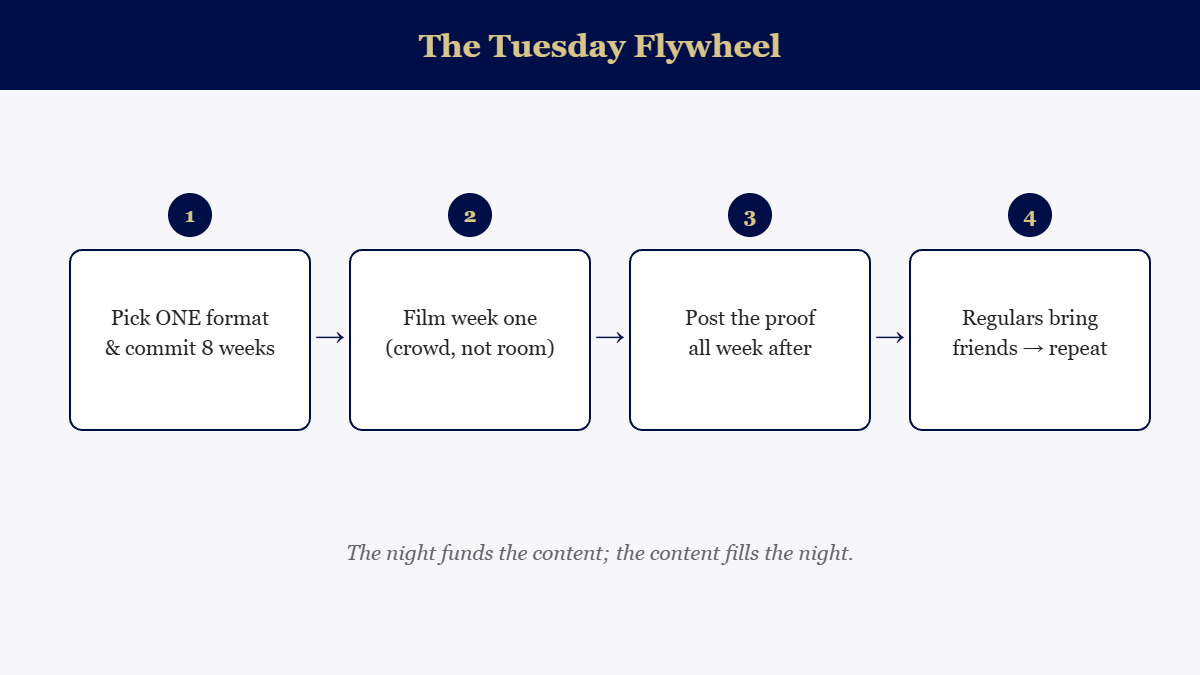
The filming step is where most venues under-invest, and it’s the engine. Point the camera at people enjoying the format — the table celebrating a trivia win, the singalong — not at the empty-ish room. That footage becomes the week’s stories and a reel, which is the only honest way to advertise a Tuesday: proof it’s alive. One professionally shot night can seed a month of this material, which is exactly the shoot-night model we run for venue clients, and why our event-promo guide pairs with this one.
The discount trap (and the offer that works instead)
Half-price drinks fill a room with people who came for half-price drinks — and leave with them. Deep discounting trains the wrong behaviour and bleeds margin on your weakest night. The structure that works: a reason-to-come (the format) plus a food-led anchor offer that protects wet margin — the $25 steak, the parmy-and-pot. Food offers photograph better, feel like value rather than desperation, and give groups a reason to stay for the second round at full price. If you must discount drinks, make it conditional on the format: a jug for the winning trivia team costs almost nothing and markets itself.
Free reach: hosts, musicians and industry nights
Every format comes with a built-in promoter if you contract for it. Trivia companies have mailing lists; musicians have followings measured in exactly the locals you want; industry-night guests are professionally networked. Make cross-posting part of the booking — a collab post on announcement, a story on the day — and your reach multiplies at zero spend. Add the basics that catch intent you didn’t create: the night listed on your Google Business Profile as a recurring event, and a small geo-targeted boost inside 3–5 km on the day (the full targeting logic is in our club-event playbook, and it applies straight to weekly nights via managed ads when you’re ready to scale it).
The eight-week commitment (and when to quit)
Week one flatters you (friends show up). Weeks two and three humble you — this is where most venues kill the night, precisely when the early regulars are deciding whether it’s a habit. Hold the line to week eight with the flywheel running, then judge on trend: are tables rebooking? Is the same crowd growing sideways — bringing one more person? If yes, you’ve built an asset; protect it. If genuinely flat by week eight with consistent content, the format’s wrong for your room — switch formats, keep the night. The worst outcome isn’t a failed trivia night; it’s a venue that’s “tried everything” for three weeks each and built nothing.
Want the flywheel run for you — shoot night, edits, posting, boosts — while your team runs the bar? Book a free consultation or call 07 2142 4335.
The staffing detail that decides whether the night survives
A recurring night lives or dies on one rostering decision: who owns it. Not “the team” — a person. The bartender who genuinely likes trivia, the duty manager who books the musicians and greets the regulars by name. Ownership shows up in a hundred small ways customers feel — the mic works, the winning team’s photo goes up, the same faces welcome them back — and it costs nothing beyond putting the right name against the night. Venues where the weekly night is everyone’s job and no one’s responsibility are the ones asking why it fizzled by week five.
Stacking nights: when Tuesday works, don’t clone it
The tempting sequel to a working Tuesday is copying it onto Wednesday. Resist it — two identical nights split one habit instead of building two. Stack different formats for different crowds: trivia Tuesday for the after-work groups, acoustic Thursday for the date crowd. Each night gets its own flywheel, its own content, its own regulars — and your midweek stops being a single bet. The sequencing matters too: bed the first night in for a full quarter before launching the second, so the team’s attention (and your content calendar) isn’t split while habit number one is still fragile.
← Explore all our Brisbane marketing guides
Want this handled for you? See our bar & nightclub video in Brisbane — from $140.
Frequently asked questions
What’s the best midweek promotion for a bar?
The one you can sustain for eight straight weeks. Trivia and kitchen-led value nights are the easiest to run consistently; live music and themed nights pull harder but need more organising. Fit the format to your crowd and your staffing, then commit — consistency builds the habit, not the concept.
How long before a new weekly night starts working?
Plan for six to eight weeks. Week one is friends and regulars; the habit forms around week four if the content loop is running; by week eight you know honestly whether the format fits. Most venues quit at week three — right before the turn.
Should I discount drinks to fill quiet nights?
Discounts alone attract price-hunters who vanish with the discount. A reason-to-come (trivia, music, an event) plus a modest food-led offer holds margin and builds a crowd that returns at full price on other nights.
How do I promote a weekly night without a marketing budget?
Film it. One well-shot night gives you a week of stories and reels — the proof that the room is alive is the promotion. Add free cross-posts from your host, musicians or trivia company, and the flywheel runs on content, not spend.